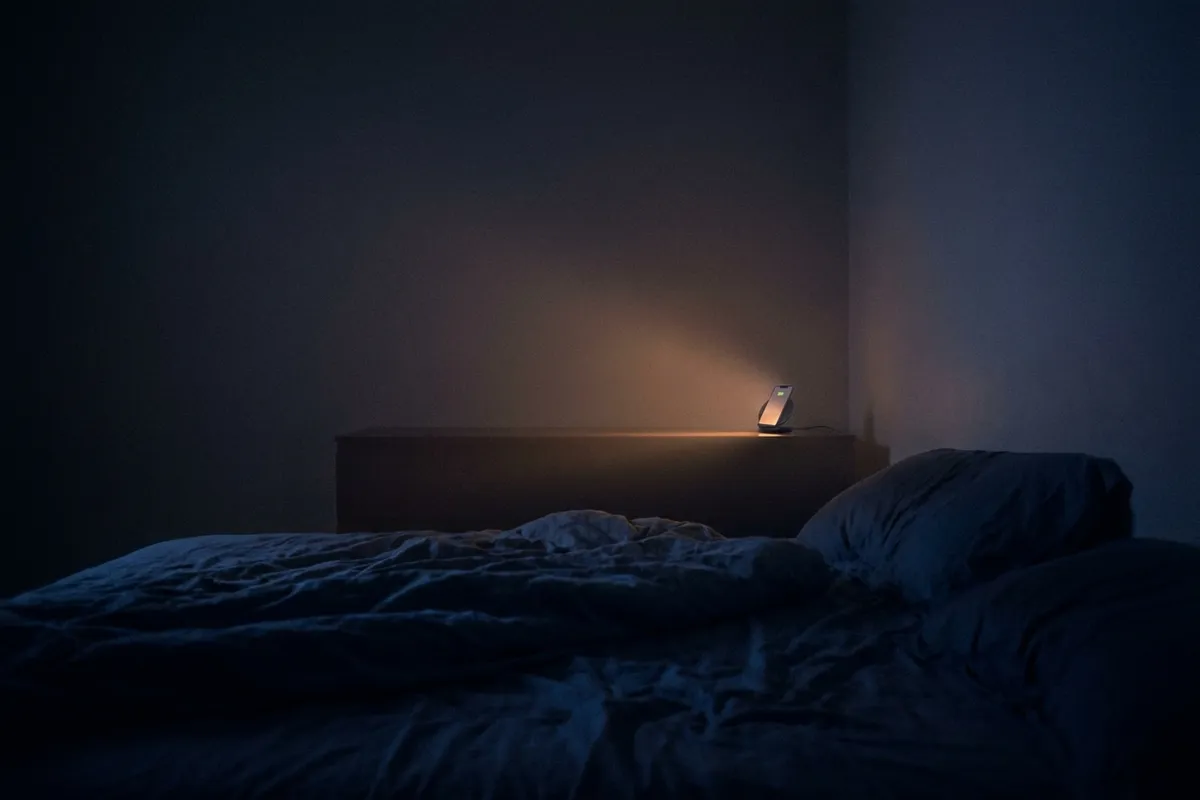
The room has gone dim around you. A glass sits on the table with one last half-moon of water in it. Your phone is warm in your hand. Somewhere in the apartment, the toothbrush waits in its small cup like a witness.
You know you need to go to bed.
You may even want to go to bed. Not in the vague, responsible way people talk about sleep, but with your whole body. Your eyes feel sandy. Your neck aches from the angle of the couch. Morning is already beginning to gather its little punishments. The alarm. The inbox. The light coming through the blinds too soon.
And still, you do not move.
This is ADHD bedtime paralysis: the feeling of being too tired to move, yet unable to sleep.
It’s a common state of executive dysfunction, where the bridge between wanting and doing goes dark. But there’s a gentle way to cross it—not by forcing a full routine, but by taking one absurdly small first step.
You Want to Go to Bed. Why Can't You Move?
This is the particular ache of ADHD bedtime paralysis: being awake, aware, tired, and somehow unable to begin the ordinary sequence that would carry you toward sleep. Stand up. Walk to the bathroom. Brush teeth. Wash face. Change clothes. Plug in phone. Turn off lamp. Lie down. These are tiny actions by daylight. At night, they can feel like crossing a cold river stone by stone.
If you have searched "ADHD can't go to bed" or "why can't I make myself go to bed ADHD," you may have felt embarrassed by the question itself. How can something so basic become so difficult? How can a person want rest and still sit frozen under a blanket, thumb moving, mind buzzing, body refusing to start?
There is nothing morally wrong with you in that moment. You are not weak. You are not secretly choosing ruin. You are caught in a nervous system state where the bridge between wanting and doing has gone dark.
When the Next Step Is Behind Glass
People often misunderstand this because from the outside it looks like delay. It looks like laziness. It looks like you are simply scrolling, simply sitting, simply ignoring your own needs. But from the inside, it can feel almost physical. Like the floor has turned to mud. Like the next step exists behind glass.
Naming the Stuckness
Naming it helps. ADHD bedtime paralysis is not an official diagnosis, but it is a very real description of a common ADHD night problem. It is executive dysfunction at bedtime. It is task initiation trouble wearing pajamas. It is the moment when sleep is the destination, but beginning is the impossible part.
You are not alone in that stillness. Many people with ADHD reach the end of the day and find themselves stranded just before bed, unable to cross the last few feet into care.
This Isn't Laziness, It's Executive Dysfunction
ADHD is not a failure of desire. It is a difference in regulation: attention, energy, time, emotion, and action. The word that often holds all of this together is Executive Dysfunction. Executive functions are the brain's quiet managers. They help you start tasks, switch tasks, remember the next step, estimate time, and keep a goal alive long enough to act on it.
At bedtime, those managers are tired too.
Task Initiation and the Chemical of 'Go'
The ADHD brain often has trouble with Task Initiation, which is the ability to begin an action even when you know it matters. Beginning is not simple. Beginning requires the brain to gather enough activation to move from intention into motion. Dopamine is part of that system. Dopamine helps with motivation, reward, novelty, and the feeling that an action is worth starting. It is not just the "pleasure chemical." It is also a chemical of go.
Why Bedtime Is Low-Dopamine
Now look at bedtime through that lens.
Going to bed is usually low-dopamine. There is no bright reward at the beginning of brushing your teeth. No novelty in washing your face. No immediate thrill in changing into old cotton. Bedtime also asks you to stop whatever is currently giving your brain stimulation: a show, a game, a text thread, a cascade of videos, the tiny slot machine of ADHD doom scrolling before bed. Your brain is being asked to leave a warm, bright, unpredictable source of dopamine for a dark room and a list of chores.
That is hard. Neurologically hard.
Transition Friction and Time Blindness
There is also Transition Friction. A transition is not just one action. It is the mental cost of shifting states. Awake to asleep. Public self to private self. Phone world to body world. Sitting to standing. The default mode network, a set of brain regions active during wandering thought and self-reflection, may grow louder at night when the day finally stops pressing on you. Cortisol, the alertness hormone, can rise when you feel stressed about time passing. The vagus nerve helps regulate the body's shift toward calm, but it does not always flip the switch just because the clock says midnight.
Then comes Time Blindness — a well-documented feature of ADHD temporal processing (Toplak et al., Journal of Neuroscience Methods, 2006). Ten minutes becomes an hour. One more video becomes the strange blue light of 1:37 a.m. The future consequence of tomorrow's exhaustion may feel abstract, while the present relief of not moving feels immediate.
This is why "just go to bed" is such useless advice. If you could just go, you would. The problem is not knowing what to do. The problem is getting the brain and body to begin.
For more on the way nighttime thought can become loud and sticky, you might find comfort in Why You Can't Shut Your Brain Off at Night. ADHD bedtime paralysis often comes with that same sense of mental noise: the lights are off outside, but not inside.
Bedtime Paralysis vs. Revenge Bedtime Procrastination
It is worth separating two experiences that often get tangled together: Revenge Bedtime Procrastination and ADHD bedtime paralysis.
The Only Unclaimed Country
Revenge Bedtime Procrastination is the deliberate delaying of sleep to reclaim time that did not feel like yours during the day. Maybe work consumed you. Maybe children needed you. Maybe your hours were chopped into obligations, errands, emails, dishes, noise. Night becomes the only unclaimed country. You stay up not because it is wise, but because it is yours. You watch another episode. You read another chapter. You let the quiet room hold you open for a while.
There can be grief in that. There can be a fierce little dignity in it too.
ADHD bedtime paralysis is different. It may look similar from the outside, especially if a phone is involved, but the inner texture is not the same. Bedtime paralysis is not usually an active declaration of "I refuse to sleep." It is more like "I want to sleep, but I cannot make myself start." It often comes with anxiety, shame, and a trapped feeling. You may be angry at yourself. You may watch the clock with dread. You may think, over and over, Get up. Get up. Get up. And still your legs stay under the blanket.
When the Remedy Is Different
This distinction matters because the remedy is different.
If you are practicing revenge bedtime procrastination, the deeper need may be autonomy. You may need more true rest or pleasure earlier in the day, so night does not have to become a rebellion. You may need to protect a pocket of time that belongs only to you.
If you are in ADHD bedtime paralysis, the need is often not persuasion. You do not need a lecture about sleep hygiene. You need less friction. You need a first step so small that your nervous system does not have time to object.
Of course, the two can overlap. You might begin the night with revenge bedtime procrastination and end it in paralysis. The first hour may feel chosen. The second may feel sticky. By the third, you are no longer enjoying yourself. You are held in place by executive dysfunction at bedtime, lit by a screen you no longer even like.
Teaching Bed to Mean Sleep
This is where Stimulus Control can help, though the phrase sounds more severe than it is. In sleep science, stimulus control means teaching your brain to associate bed with sleep rather than scrolling, working, worrying, or waiting. For ADHD, the goal is not perfection. The goal is gentleness and repetition. Bed becomes the place where the day is allowed to end.
The 'One Thing' Trick to Break the Inertia
When you are stuck, the whole bedtime routine is too large. It arrives as a crowd. Brush teeth, wash face, take medication, find pajamas, set alarm, lock door, fill water bottle, move laundry, choose tomorrow's clothes, stop scrolling, be a better person, fix your entire life by morning.
No wonder the body goes still.
Ask for One Thing
The trick is to stop asking yourself to go to bed.
Ask yourself to do one thing.
Not one productive thing. Not the perfect first step. Not the step that guarantees success. One tiny action that is almost too small to respect. Put your phone face down. Move one foot to the floor. Take one sip of water. Turn off one lamp. Stand up without deciding what happens after. Carry your toothbrush to the sink and do nothing else yet.
This is the "One Thing" trick. It works because ADHD paralysis often feeds on the size and vagueness of the task. "Get ready for bed" is not one task. It is a swarm. Your brain cannot find the handle. A tiny action gives the brain a handle.