
The room has gone soft around the edges. Maybe the radiator knocks once and then goes quiet. Maybe a thin stripe of streetlight lies across the ceiling. The pillow is cool when you first turn your face into it, and for a few seconds, it seems possible that sleep might come simply because you have asked it to.
Then your hand reaches for the phone.
Not with drama. Not even with a clear decision. The movement is small, practiced, nearly tender. Thumb to screen. Face lit blue. One notification, one message, one video, one comment thread, one headline you did not need at this hour. The dark room disappears into the rectangle. Your body is in bed, but your mind is suddenly everywhere else.
Breaking the bedtime scroll habit isn't about more willpower, it's about giving your hands and mind a kinder place to land.
The key is habit replacement: swapping the screen for a simple, sensory ritual that calms your nervous system instead of activating it. This guide offers a gentle, practical path to putting the phone down and picking your peace back up.
That Familiar Blue Glow in the Dark
If you are searching for how to break the bedtime scroll habit, you probably already know the habit is not helping. You do not need a lecture. You know the particular shame of saying, "Just five more minutes," while some quiet part of you understands that five minutes has become a kind of fiction. The clock moves from 10:48 to 11:37 without asking permission. Your eyes feel dry. Your jaw is tight. The pillow is warm now. Sleep, which once seemed close, has stepped back from the bed.
The Scroll Begins as Self-Care
This is the strange tenderness of phone addiction before bed: it often begins as an attempt to take care of yourself. You want a little comfort. A little company. A little sense that the day is yours again after hours of being needed, watched, managed, measured. The scroll feels like a private room you can enter with one hand. No one can ask anything of you there, at least not at first.
When the Private Room Keeps Changing Shape
But the room keeps changing shape. A joke becomes a tragedy. A recipe becomes a stranger's perfect kitchen. A friend's vacation becomes a small ache. Doomscrolling at night turns rest into vigilance. The phone promises to soothe you, then keeps you awake enough to need more soothing.
You are not weak because the glow keeps calling. You are tired, and the glow has learned your tiredness well.
Breaking the habit is not about becoming a stricter person in the dark. It is about giving that tired hand somewhere else to go.
Your Brain on 'The Scroll': A Quick and Draining Loop
The scroll is not compelling because you lack discipline. It is compelling because it is built around what psychologists call the incentive-salience model — dopamine firing not for pleasure itself, but for the anticipation of it.

Dopamine Is a Spark of Wanting
Dopamine is not simply a pleasure chemical, though people often describe it that way. It is more like a little spark of wanting. It rises when your brain thinks something interesting may be about to happen. Infinite scroll understands this beautifully. Most posts are forgettable. Some are funny. Some are alarming. Some make you feel briefly seen. Some make you feel left out. Because you never know which one is coming next, your brain keeps reaching.
This is called intermittent reward. It is the same pattern that makes a slot machine hard to leave. Not every pull gives you something, but the next one might. Your thumb becomes the lever. Your bed becomes the casino carpet. The hour becomes strange.
Blue Light and the Confused Dimming
At the same time, the phone gives your body signals that do not match the room you are in. Blue light from the screen can contribute to melatonin suppression, as a landmark PNAS study on evening e-reader use confirmed. Melatonin is one of the hormones that helps your body understand that night has arrived. It is not a sleeping pill made inside you; it is more like a dimming of the house lights. When your face is close to a bright screen in a dark room, that dimming gets confused.
Then there is the content itself. The news item that opens a door in your chest. The comment section full of strangers sharpening their knives. The social comparison that arrives so quickly you barely notice it: someone is more beautiful, more organized, more loved, more awake to life. Your default mode network, the brain system that loves self-referential thinking, starts humming. What does this mean about me? Why am I behind? What if things get worse?
A Buffet of Unfinished Emotional Tasks
No wonder your brain feels wired after scrolling. It has been asked to process jokes, grief, outrage, beauty, envy, fear, gossip, and global instability in the same ten-minute span. Your nervous system cannot always tell the difference between a tiger in the grass and a headline about tigers in every field. Cortisol, the hormone that helps you mobilize for stress, may stay higher than you want it to be at bedtime. The vagus nerve, which helps the body shift toward calm, does not get much of a chance when every few seconds another bright little signal arrives.
If you often feel like you can't shut your brain off at night, the bedtime scroll may be one reason the mental lights keep flickering. You are not just "checking your phone." You are feeding your tired mind a buffet of unfinished emotional tasks.
Why 'Just Stop' Isn't Helpful Advice
"Just stop" sounds clean in daylight. It sounds reasonable when you are standing in the kitchen at noon, holding a mug of coffee, making a plan for the better person you will become tonight. No phone in bed. Lights out by ten. A book, maybe. A glass of water. Peace.
Then Night Comes With Its Old Weather
Then night comes with its old weather.
You are tired. The house is finally quiet. Your defenses are low. The part of you that wants long-term wellbeing is still real, but so is the part of you that wants one easy hit of relief. The phone is right there, warm from charging, familiar as a worry stone. If the only plan is to not pick it up, you have asked a tired brain to create a void and then sit politely beside it.
Every Habit Has a Cue, a Routine, and a Reward
Habits do not usually disappear because we disapprove of them. A habit is an automatic behavior that fills a need. It has a cue, a routine, and a reward. The cue might be getting into bed. The routine is opening the phone. The reward is stimulation, distraction, comfort, company, or the feeling of control after a day that did not offer much of it.
When you are wondering how to stop scrolling on your phone at night, the better question may be: what need is the scrolling trying to meet?
Maybe you need a transition. The day has been loud, and you cannot go from dishes, email, children, deadlines, or loneliness straight into unconsciousness. Maybe you need touch: the weight of something in your hands. Maybe you need a voice. Maybe you need to feel that someone is with you in the dark, but not demanding anything.
Replacement, Not Punishment
This is why habit replacement matters more than punishment. You are not simply removing the phone. You are giving your body a new sequence it can learn. Habit stacking can help here: you attach the new ritual to something you already do. After I brush my teeth, I plug my phone in across the room. After I turn off the overhead light, I make tea. After I get into bed, I listen instead of look.
The brain loves repetition when repetition is kind. At first, the new ritual may feel less shiny. Of course it will. It has not been engineered by thousands of designers and tested against your attention. But it can become dependable in a deeper way. The nervous system learns through cues. Same lamp. Same cup. Same blanket. Same voice. Same small mercy.
There is a whole essay hiding inside that word: replacement. Not deprivation. Not exile. Not a cold, moral victory over yourself. Replacement means the need is honored, but the method changes. You still get a doorway out of the day. You just choose one that does not lead into another hour of unrest.
Finding a Better Anchor: What to Do With Your Hands (and Mind)
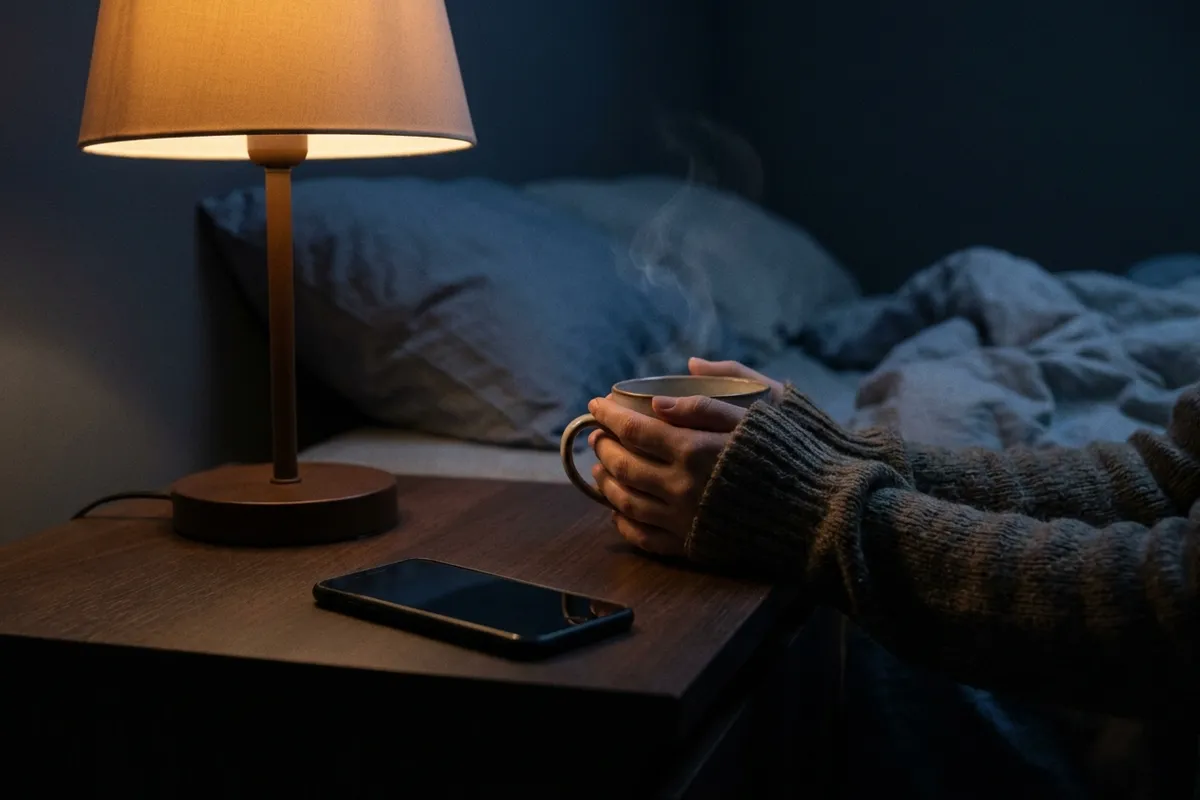
The first step is plain and physical: charge the phone across the room.

Put a Moat Between Impulse and Action
Not beside the bed. Not under the pillow. Not on the nightstand face down, where it still hums like a secret. Across the room is better. Outside the bedroom is better still, if you can manage it. The point is not to become unreachable or austere. The point is to add one small moat between impulse and action. If you truly need the phone, you can stand up. Most nights, that little bit of standing will reveal the truth: you did not need it. You were reaching.