It’s impossible to rest when your mind won’t stop. Learn how to quiet a loud mind to sleep with a simple Auditory Anchor technique that doesn’t ask you to “clear your mind.”
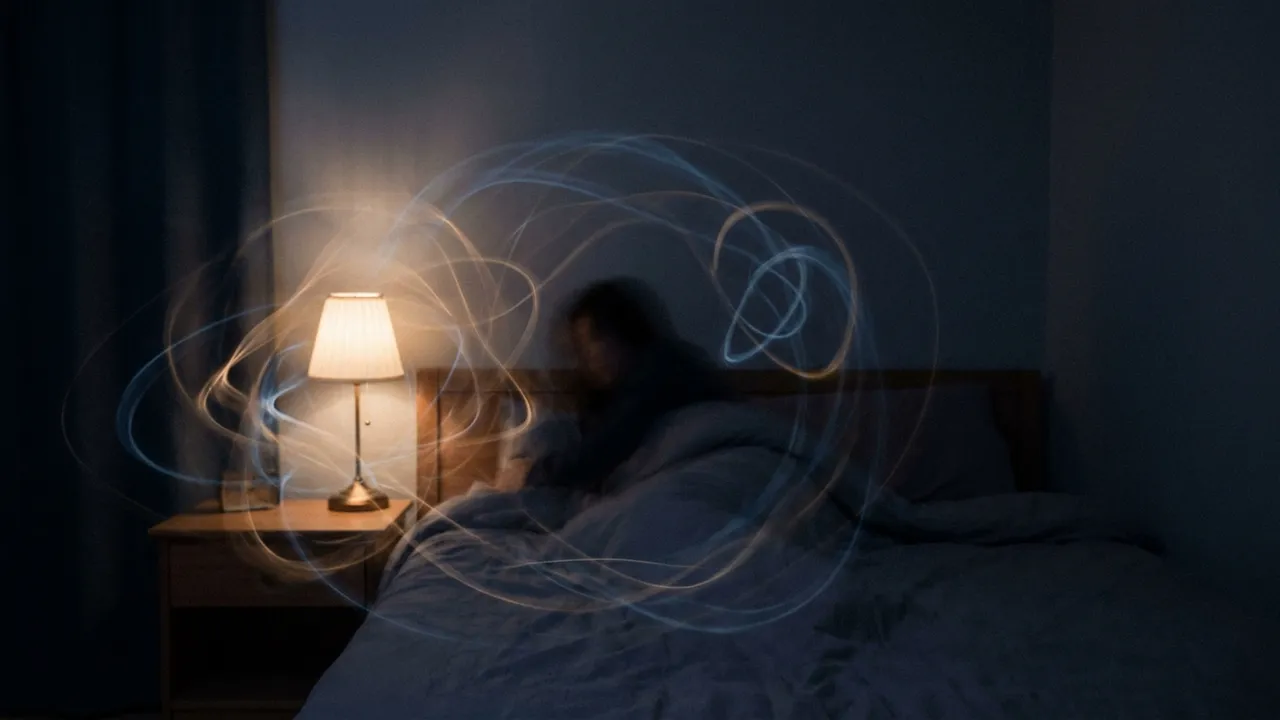
The room is dark. The pillow is warm in one place, cool in another. Somewhere in the walls, a pipe knocks once and goes quiet. Your body has done what it was supposed to do. It has come to bed. It has turned off the lamp. It has stopped answering messages. It has made the shape of sleep.
But your mind is still lit up.
It sounds like a radio stuck between stations. Static first. Then a voice saying you forgot to reply to someone. Static again. A little song from a grocery store aisle. A memory from ninth grade, sour as metal. Tomorrow's list. The thing you said in the meeting. The bill. The birthday. The strange pain in your shoulder. Another voice, louder now, asking why you are still awake.
When your mind is too loud to sleep, the last thing you need is a struggle. Instead of trying to force silence, the key is to give your attention a simple, gentle focus.
The most effective technique is to use an 'Auditory Anchor'—a single, calm sound you can rest your awareness on, allowing racing thoughts to fade into the background without a fight.
If this is where you are, the first thing to know is gentle: you do not have to win a fight with your mind tonight. You only need to give it somewhere softer to go.
That feeling when your mind won't stop talking
This is the private weather of a loud mind at night. Not one thought, but many. Not a clear fear, always, but a crowd. If you have ever whispered, I can't turn my brain off at night, you know the particular exhaustion of being trapped in your own head when all you want is peace.
It's Not Weakness — It's Cognitive Overload
It is not that you are weak. It is not that you are bad at rest. Often, it is Cognitive Overload: too much held for too long, with nowhere to set it down. The mind keeps touching every object it could not finish during the day. It opens drawers. It checks locks. It replays voices. Your brain is too loud to sleep because, in the dark, everything you outran finally catches up.
The Loneliness of Being the Only One Awake
There is a loneliness to it, even if someone is sleeping inches away. Their breath has found a rhythm. Yours has not. The ceiling becomes a screen. The sheets become a border. You lie there thinking, my brain is too loud to sleep, and the thought itself becomes another station in the static.
Why 'just clear your mind' is the worst advice
"Just clear your mind" sounds peaceful until you try it at 12:47 a.m.
The instruction arrives like a clean white room. Empty. Quiet. Impossible. You close your eyes and attempt to think of nothing. Almost immediately, nothing becomes something. A blank space becomes a test. A test becomes pressure. Pressure becomes alertness. Now you are not only awake; you are awake and failing.
The Clean White Room That Becomes a Test
This is why the advice can feel so cruel. It asks a tired person to perform an advanced mental trick at the exact moment their mind is least able to perform. It turns sleep into an exam you did not study for.
Paradoxical Intention: The Harder You Push, the Louder It Gets
There is a name for part of this trap: Paradoxical Intention. When you try very hard not to think about something, you often strengthen the thought — a phenomenon psychologist Daniel Wegner demonstrated in a landmark study in the Journal of Personality and Social Psychology (1987), showing that suppressed thoughts rebound with greater intensity. Tell yourself not to think about the email, and the email arrives with a chair and sits beside you. Tell yourself not to worry, and worry starts checking the windows. Tell yourself you must sleep now, and your body hears urgency, not safety.
This is also why many techniques to quiet the mind fail when they are framed as control. The mind does not like being pinned down. Overthinking feeds on resistance. The more you shove a thought away, the more proof your nervous system gathers that the thought matters.
A Quieter Way: A Place to Rest, Not Emptiness
If you came here searching how to stop overthinking at night, you may have already tried the usual things. You may have counted sheep until they became debts. You may have breathed in squares. You may have told yourself that your concerns can wait until morning, only to watch them return wearing new clothes.
None of this means you are doing it wrong.
A quieter way begins when you stop trying to erase thought. You let the mind be a living thing. Busy. Protective. Sometimes dramatic. Then you offer it a task small enough to do in the dark.
Not emptiness.
A place to rest.
If you want a deeper look at why this happens, we wrote about why you can't shut your brain off at night. The short version is this: your mind is not a light switch. It is more like a hand that needs something calm to hold.
The science of a 'loud mind' at night
During the day, your attention has handles. A sink full of dishes. A calendar. A child asking for socks. A document on a glowing screen. A street to cross. Even unpleasant tasks give the brain a direction. Do this. Answer that. Move here. Look there.
Then night comes and removes the handles.
Meet the Default Mode Network: The Midnight Committee
The room dims. The phone is facedown, or should be. The body stops moving. There is less to see, less to solve, less to organize outside yourself. Into that quiet steps the Default Mode Network, often shortened to DMN.
The Default Mode Network is a set of brain regions that becomes active when you are not focused on an outside task. It is involved in mind-wandering, memory, self-reflection, imagining the future, and thinking about yourself in relation to other people. In a calm hour, it can be part of daydreaming. In a strained hour, it can become the midnight committee.
At night, if your mind is too busy to sleep, the DMN may start stitching together every unfinished thread. What did she mean by that text? What if tomorrow goes badly? Why did I say that in 2018? What if I never feel rested again? The thoughts can be random, but the body reads them as important. Cortisol, the hormone associated with stress and alertness, may stay higher than you want it to be. Your vagus nerve, which helps regulate the shift toward calm, may not get the signal that the house is safe now.
Racing Thoughts: When Anxiety Makes the Mind Louder
This is especially true with racing thoughts at night anxiety. Anxiety narrows the world while making the mind louder. It says, solve this before you sleep. But many night thoughts cannot be solved at night. They can only be rehearsed, and rehearsal keeps the stage lights on.
The Problem Isn't Thought — It's Unheld Thought
The problem is not thought itself. Thought is what minds do. The problem is unheld thought, thought without a bank or bowl or boundary. The DMN needs a gentle counterweight. Not a command to shut down, but a focus that is simple enough to follow and steady enough to return to.
Mindfulness sometimes helps because it teaches you to notice thoughts without climbing inside them. Cognitive Shuffle can help some people because it asks the brain to imagine neutral, unrelated images, loosening the grip of narrative. But when you are tired, even choosing images can feel like work.
Sound asks less of you.
A voice. Rain. A low hum. One thread through the dark.
The Auditory Anchor: Give your brain a better job
An Auditory Anchor is a single source of sound you rest your attention on when your mind is loud. It might be a calm voice — a carefully crafted AI voice can carry the same warmth. It might be soft rain in leaves. It might be the faint hush of waves, a low drone, a piece of music without sharp edges. The sound is not there to entertain you. It is not there to drown you out. It is there to give your mind one gentle job.
Listen here.
That is all.
Redirect the Mind, Don't Fight It
Instead of fighting the Default Mode Network, you are redirecting it. A restless puppy will chew the table leg if it has nothing else to do. You do not lecture the puppy about furniture. You give it a toy. Not as punishment. As kindness. The mind, too, can be given something harmless to hold in its mouth.
This is the heart of how to quiet a loud mind to sleep: stop asking for silence first. Ask for relationship. Let the sound be near you. Let it be more interesting than the spiral, but not so interesting that it keeps you awake. It should have a texture you can return to without effort.
Why an Anchor Works: Attention Is Limited
A good Auditory Anchor works because attention is limited. Your brain can jump, yes, but it cannot fully inhabit every channel at once. When you rest attention on a steady sound, even lightly, you reduce the space available for spiraling thoughts. You give the mind a path worn smooth by repetition.
This is different from blasting noise over your inner life. It is also different from scrolling until exhaustion takes you. The anchor should not flood you with blue light, novelty, or urgency. It should lower the room. It should make fewer demands as the minutes pass.
Before Language Was Content, It Was Tone
A warm voice can be especially powerful here — and a carefully crafted AI voice, shaped for slowness and tone, can carry those same qualities. Before language was content, it was tone. A nervous system hears pace, warmth, breath, and safety. This is why a lullaby can work before a child understands the words — a study in Nature Human Behaviour found that infants relaxed in response to unfamiliar foreign lullabies, responding to musical structure rather than meaning. This is why, even as an adult, the right voice can feel like a hand placed gently between your shoulder blades.
If white noise has ever felt too blank, or meditation apps too bright and instructional, you are not alone. We explore that difference in why white noise and meditation apps fail. Sometimes the missing thing is not more sound. It is a sound with care inside it.
How to use an Auditory Anchor tonight
Tonight, do not make this elaborate. The mind loves turning help into homework. Keep it small enough that you can do it with tired eyes.
First, Choose One Anchor
First, choose your anchor. Pick one sound or one voice. Not a queue of choices. Not a playlist you keep adjusting. You might choose quiet rain, a simple soundscape, a familiar narrator, or a slow bedtime story with no sharp plot. If lyrics pull you into memory, avoid them. If silence makes your thoughts louder, let the anchor be audible but soft. The volume should feel like a lamp under a shade, not an overhead light.
Second, Listen With a Loose Hand
Second, listen with a loose hand. You are not concentrating the way you would study a map. You are letting awareness lean toward the sound. Notice the grain of the voice. The space between sentences. The way rain arrives in tiny beads. The low edge of a note. If you miss a sentence, nothing has gone wrong. If the sound fades into the background, that may be fine too. You are not trying to capture it. You are letting it be there.
Third, Guide It Back Kindly
Third, and this is the whole practice: when your mind wanders, guide it back kindly.
It will wander. It may wander ten times in one minute. You may suddenly find yourself planning breakfast, replaying a conversation, or wondering whether the front door is locked. The moment you notice, do not scold yourself. Do not announce failure. Just return to the sound. Back to the voice. Back to the rain. Back to the hum.
A simple sequence can help: 1. Notice the thought. 2. Name it softly, if you want: planning, remembering, worrying. 3. Return to the anchor. That is enough.
The goal is redirection, not perfection. Every return is the practice. Every return tells the nervous system, we do not have to follow that right now. Over time, this can help with how to stop spiraling thoughts before bed because you are no longer feeding the spiral with argument. You are stepping off it, gently, again and again.
Let the Page Hold It Until Morning
If a thought feels important, keep a notebook nearby. Write one dull line: "Call dentist." "Check invoice." "Ask Sam." Then go back to the anchor. No essays. No problem-solving under the covers. The page can hold the thought until morning.
If the sound irritates you, change it tomorrow, not twenty times tonight. Rest is helped by consistency. The body likes familiar doors.
And if you wake at 3 a.m. with the same loud mind, you can use the same anchor then. We have also written about why you wake up at 3 AM every night, because that hour has its own strange acoustics. The technique remains the same: one sound, one return, no punishment.
An anchor for the night, every night
The hardest part of a nighttime practice is often not the practice itself. It is the choosing.
When you are already worn thin, even small decisions can feel jagged. Which sound? Which voice? Which app? How long? Is this too stimulating? Is this boring? Should you try a meditation, a story, a podcast, a fan, a breathing exercise, a Cognitive Shuffle, a sleep playlist, nothing at all?
When Choice Becomes Another Overload
Choice can become another form of Cognitive Overload. The mind that needs settling is asked to browse a shelf of possible selves. Calm person. Disciplined person. Spiritual person. Productive person who has optimized sleep. None of these are necessary. You do not need a better personality at bedtime. You need a reliable threshold.
Why a Dedicated Ritual Helps
This is where a dedicated ritual can help. An anchor becomes stronger when it is repeated in the same way, night after night. The nervous system learns through pattern. Low light. Screen down. Same kind of voice. Same kind of pacing. The day is over. You are allowed to leave it.
A purpose-built auditory ritual removes the guesswork. It gives you a soundscape that does not ask to be managed, and a voice that does not hurry you toward enlightenment. It meets you in the actual condition of night: rumpled, tender, overstimulated, maybe a little ashamed that you are still awake. It does not tell you to clear your mind. It gives your mind one small, warm place to return to.
That return matters. It is how the practice becomes less like a technique and more like a path through your own house in the dark. At first, you may need to feel for the wall. Later, your body remembers where to turn.
Less Force, Less Glare, Less Self-Criticism
How to quiet a loud mind to sleep is not a secret reserved for people with perfect routines. It is a practice of lowering the demands. Less force. Less glare. Less self-criticism. A sound you trust. A voice you can come back to. A night that does not need you to solve your whole life before you rest.
You are not trying to become empty. You are trying to become held.
Tonight is being made for this exact hour: an AI-guided evening ritual with carefully crafted voices, shaped by humans for warmth, screen-free and low-light, designed to be an Auditory Anchor rather than another meditation app to manage. If you want a softer way to meet the dark, you can join the waitlist. We'll be there when the radio starts to static, and you need one kind sound to follow home.
Rather than forcing silence, it often helps to give your attention one gentle place to rest. An Auditory Anchor, such as a calm voice or soft rain, gives the mind a single, low-effort focus to return to whenever it wanders. The aim is not an empty head but a quieter relationship with the thoughts that are already there.
Why is my brain too loud to sleep at night?
During the day your attention has handles, like tasks and conversations, and at night those handles fall away. Into that quiet steps the Default Mode Network, the part of the brain that wanders, remembers, and rehearses. With nothing else to hold, it can stitch together unfinished threads, which is why a loud mind at night can feel so busy and so hard to settle.
Does trying to clear your mind actually help you sleep?
For many people it backfires. Trying hard not to think about something tends to make the thought louder, a pattern researchers call paradoxical intention. Instead of erasing thought, it is usually gentler to redirect attention toward a single calm sound and let the busier thoughts fade into the background.
What is an Auditory Anchor?
An Auditory Anchor is a single source of sound you rest your awareness on when your mind is racing. It might be a warm voice, quiet rain, the hush of waves, or a low hum, kept soft and steady so it stays in the background. Each time your attention drifts, you simply guide it back to the sound, again and again.
What is Tonight?
Tonight is a digital sleep ritual that helps you clear your mind and decompress. Through structured reflection and personalized, synthetic audio guidance, we provide a quiet, private space to help you find closure before you sleep. Private, ephemeral, and designed to help you rest.
The quiet list
Notes for a quieter mind.
Join the newsletter for occasional, thoughtful notes on sleep, emotional regulation, and building a calmer life. We only write when there’s something genuinely worth your while.