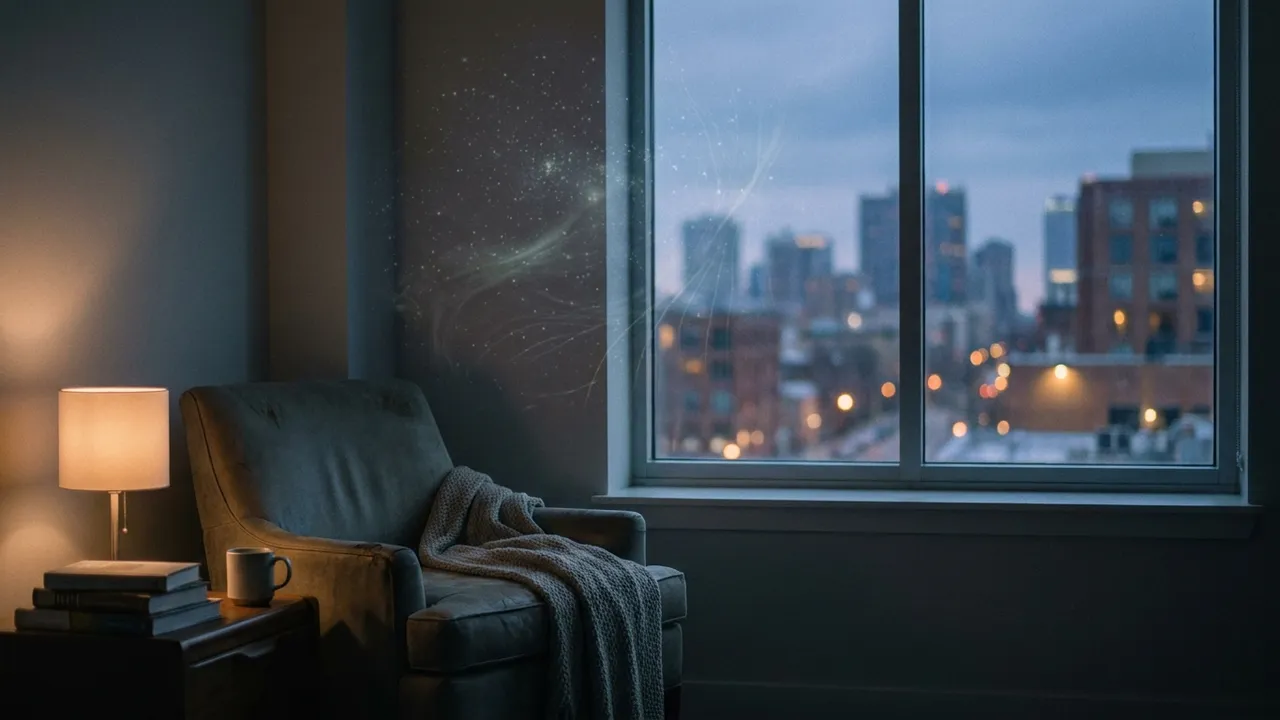
We learn to fear the morning because it brings a number. Before coffee, before the window opens, before we remember the weather, there is the verdict on our wrist or phone: a sleep score, a grade for being unconscious.
You roll over to the glow. You are told how you slept. Suddenly, you cannot remember how you felt until you saw the number. The day adjusts its light.
This is sleep tracking anxiety, a term that tastes metallic in the mouth, like licking a battery.
And yet, I understand the wish for data. We live in a world where night often feels like a failure of will. We lie down with a valise of emails, pantry lists, disputes with our past selves. A sensor promises containment, a faith that if we can only see the night, we will finally enter it. But what if the seeing is the problem? What if attention is the very wire that tightens the jaw, the glare that blanks the actor’s mind? We call it orthosomnia when the quest for perfect sleep undoes sleep itself; an exquisite little word that sounds like a ballet step and means: trying so hard to be at rest that you cannot rest.
The Uncounted Night
The Softest Tyranny Wears a Halo
There are flavors of tyranny, and the softest wears a halo of helpfulness. It doesn’t shout; it pings. The device swears it is here to keep you safe, to coach you into better cycles, to shepherd your REM like a night farmer with a flashlight. But a watched pot does not boil; a watched night does not loosen. When rest becomes a project—tracked, scored, graphed—the body becomes the intern reporting to a manager that lives in the cloud. You become a stage actor staring into the white beam of the spotlight, hearing the orchestra turn silent. Where are your lines? Where is your cue? The audience is a blue-lit screen, and it keeps asking, How did you perform in your sleep?
Sleep is not a spreadsheet. It is a tide. You do not “accomplish” a tide; you feel it loosen the sand from your ankles.
How a '62' Erases the Sparrow
There is a peculiar way a “poor” score sours a perfectly decent morning. You wake easy, the spine uncurls, a sparrow scribbles at the window. Then, the number: 62. The sparrow is erased. Your body is no longer an orchard carrying dew; it is a report card that says try harder. Coffee turns into penance. You tell your coworkers, I slept terribly, though the truth is you only started to feel terrible after you were told. Thus the algorithm writes your memory for you. The day bends around a fiction.
Naming It: Sleep Tracking Anxiety and the Watched Pot
This Isn't Just You
To name a thing is to loosen your grip from its throat. sleep tracking anxiety says, quietly: this isn’t just you. It is a pattern, a spell. We are encouraged—by gentle notifications and amber charts—to believe night is a solvable equation. We are herded into the shallow end of numbers, where feeling becomes a liability because it can’t be screenshot. We are trained to bow to the myth that control is love.
Love Is Not Control. Love Is Trust.
But love is not control. Love is trust. What does trust look like in the night? It looks like letting a cloud pass without cataloging its edges. It looks like refusing the mirror that tells you exactly how beautiful or exhausted you are, and walking into the day with your original body. It looks like remembering you have slept all your life without anyone counting for you.
Performer and Evaluator
I think of how actors warm their voices, then step into blackout and release the text from memory, not from cue cards. Every performance is a surrender to forgetting just enough to be carried by the thing itself. The moment you try to watch yourself doing it, you split in two: performer and evaluator. It is almost impossible to be both and remain whole. The same doubleness haunts the sleepless. You are the one who is trying to sleep and the one who is checking whether you’re sleeping yet. The pot steams under your gaze, refuses to boil, and then shames you for the refusal.
The Morning After the Verdict
When the Number Hovers All Day
A score can erase birdsong. A score can turn a clean pain—say, a late bedtime, a rowdy neighbor—into a dirty ache called failure. Because scores are comparative, too. They suggest a secret community of sleepers who are outpacing you, who have a better relationship with the night. You don’t know their names, but you can feel their fit bodies lapping you on a track that coils through the dark. You look down at your wrist and think, If I am a 62, what does that make me today? All day, the number hovers. You suspect you will be shorter with the barista, more brittle with love, because the app predicted “reduced readiness.” The prophecy writes itself into your spine.
Mornings Without a Measurement
There are mornings, mercifully, without a measurement. A cabin with no service, a forgotten charger. You wake, stretch like an animal, and inherit the weather of your room. On those mornings, the body keeps the only books that matter. It knows what it knows. Sometimes that knowing is simply, I am tired. And without a verdict, that statement is free of judgment. It can be met with kindness. It can be seasoned with a nap, with gentler work, with forgiving yourself for being a creature.
Two Schools: Discipline and Companionship
I do not mock those who find order in practice. Calm and Headspace, for instance, belong to one school of thought: attend to the breath, train the pulse, cultivate. There is dignity in discipline, and a grace in returning, and many have been taught to befriend night that way. Tonight lives in another school. Not a monastery, but a kitchen with the light left on. Presence over performance. Companionship over control. The kettle humming whether or not you measured its temperature.
The Myth of the Perfect Graph
Counting Syllables, Missing the Song
The charts are handsome. Blues and violets interleaved like silk—REM, deep, light. It is persuasive, this painter’s palette. It flatters us into believing that if the colors bloom in the right order, then we will bloom, too. But the chase for a perfect graph is like composing a sonnet by counting syllables only. You might meet the rule and still miss the song.
What Refuses to Be Archived
Most of what restores us at night refuses to be archived. The half-dream where your grandmother braided your hair. The way your hand found the absent shore of the beloved’s hip and rested there, as if palming a stone. The subterranean repairs impossible to witness—the liver stitching, the brain rinsing its glial streets. Even science, which I honor, admits the secrets outweigh the diagrams. Yet we fixate on the diagram like a warding charm, and the night, insulted, turns its face away.
Beware the false belief that if you can measure a mystery, you have tamed it. Some animals die of being looked at too hard.
The Holiness of 3 a.m.
I remember waking at 3 a.m. for a season so long it felt like a career. Those hours had a particular temperature, a faint metallic edge, as if the city were a field of coins. I learned the difference between panic and awe. There is a certain holiness in that time, the world unsupervised by sunlight. It helped me to read, to breathe, to listen for the hum in the walls, to discover I was not the only creature awake. If this feels familiar, you may like the uncanny feeling of waking up at 3am; not advice, just company.
What I did not do, then, was check a number to see whether my wakefulness was legitimate. I let it be a passage. I learned to stop cataloging factors—caffeine, stress, moon phase—and instead let the hour be its own animal. The body often answers more readily to tenderness than to surveillance.
Against the Blue Glow: A Short Defense of Not-Knowing
Refusing the Lens, Not the Care
To refuse measurement is not to refuse care. It is not a renunciation of curiosity. It is a way of protecting the shy thing inside the night that emerges only when unobserved. There are wonders that bruise under the lens. There are songs that vanish when recorded. Not every lily wants its pollen counted.