Is your heart racing when trying to sleep? Learn why anxiety can make your pulse pound at night, and try a simple breathing technique to calm your nervous system.
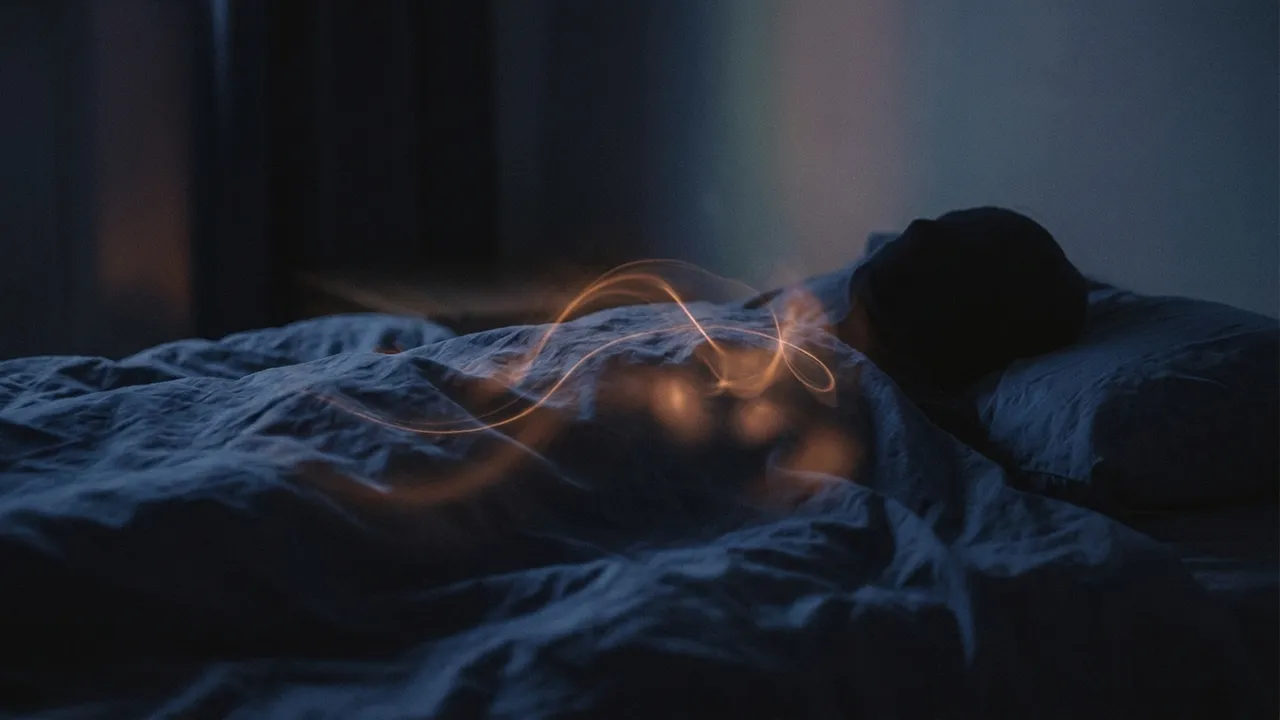
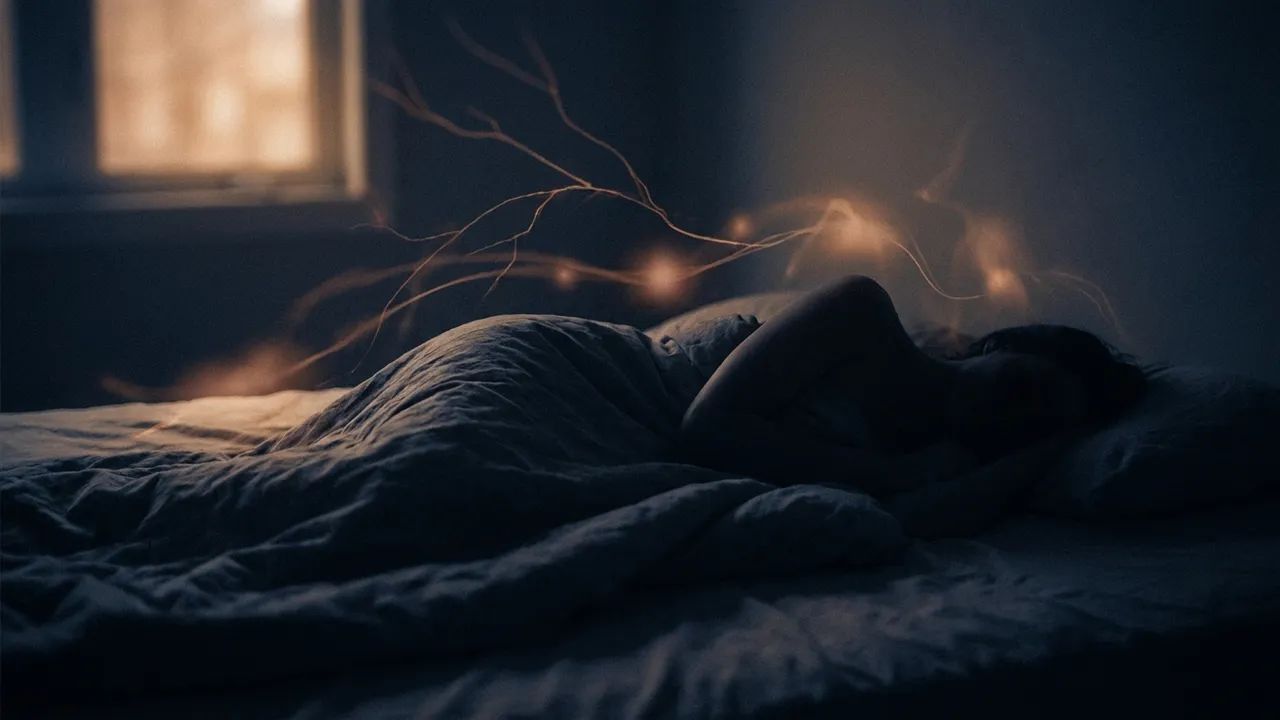
The house has gone still. The sink has stopped ticking. A car passes once, then leaves the street to silence. You are finally horizontal, cheek cooling against the pillow, blanket gathered at your ribs. Then your body seems to turn up its own volume.
A thud. Another. A quickening.
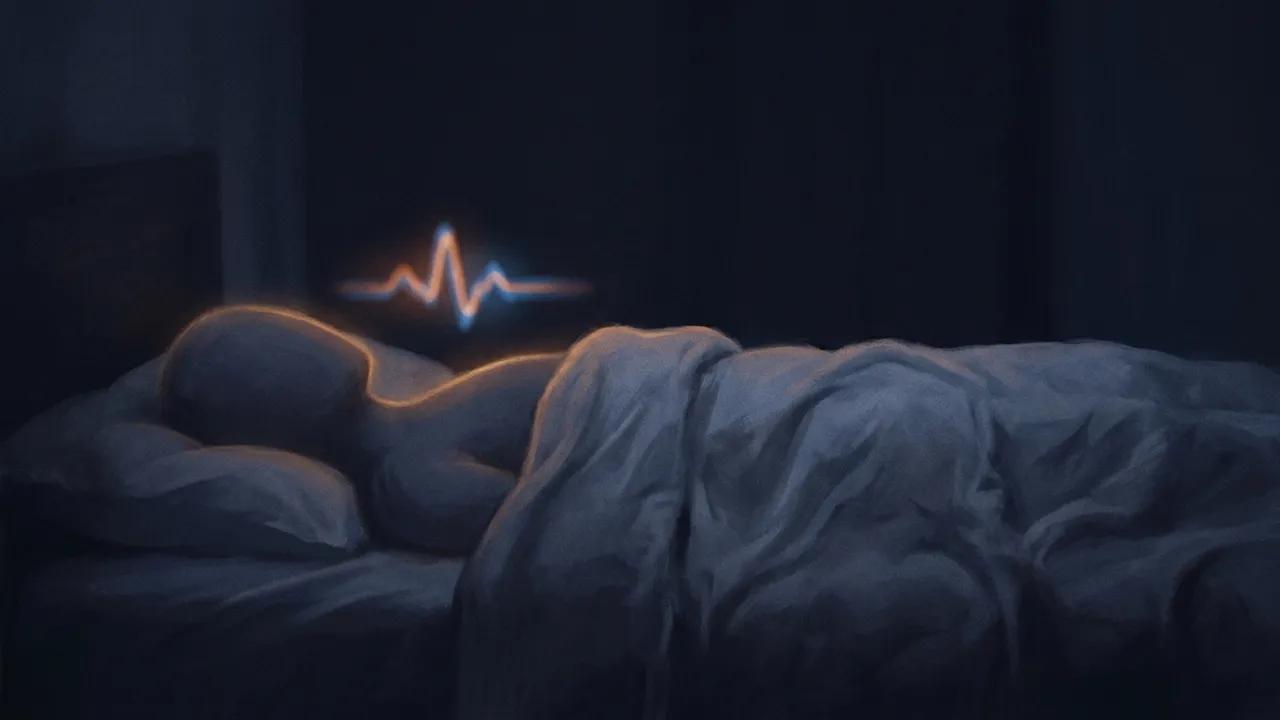
Your heart is racing when trying to sleep, and it can feel like betrayal. All day your body carried you quietly through light and errands and conversation. Now, at the exact moment you ask it to soften, it begins to pound as if something is at the door.
If your heart is racing when you're trying to sleep, it's often a sign your body's 'fight or flight' response is stuck in the 'on' position.
This physical sign of anxiety can create a feedback loop, but a specific breathing technique called the Physiological Sigh can interrupt the cycle by directly calming your nervous system.
Not in weakness. Not in drama. In wires.
The Sudden Drumbeat in the Dark
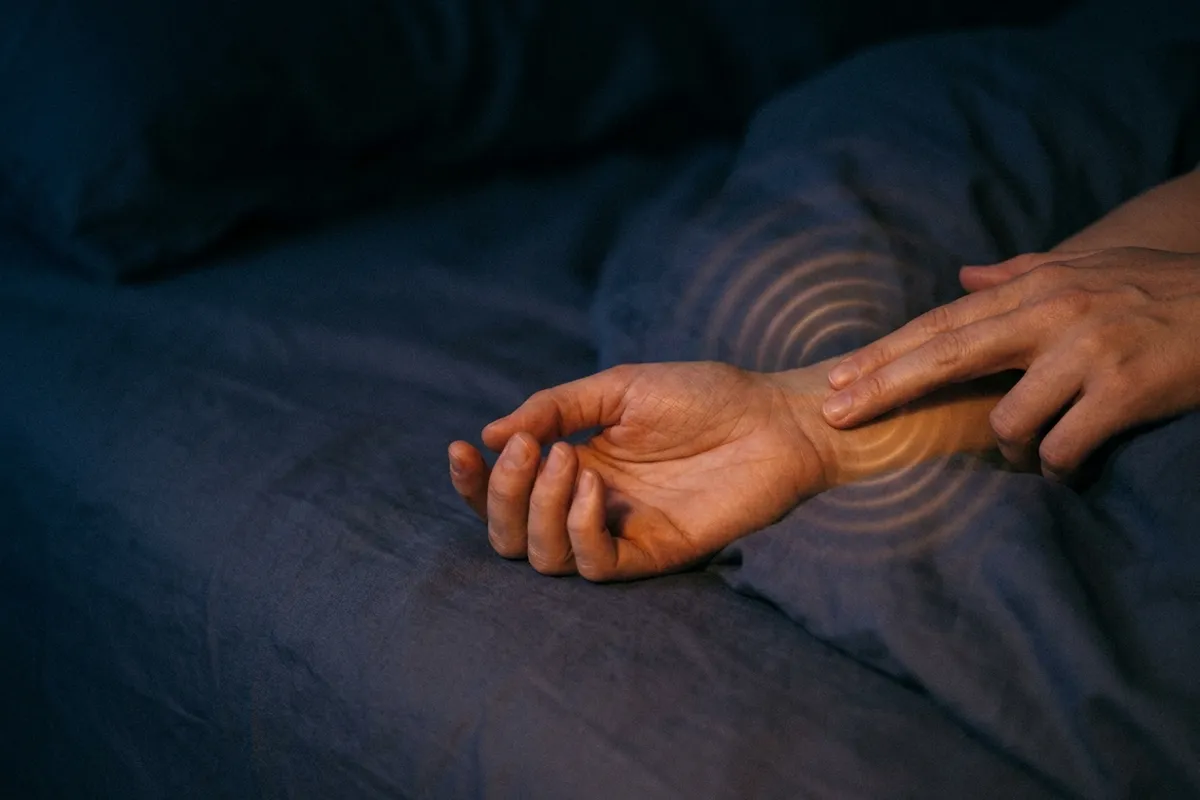
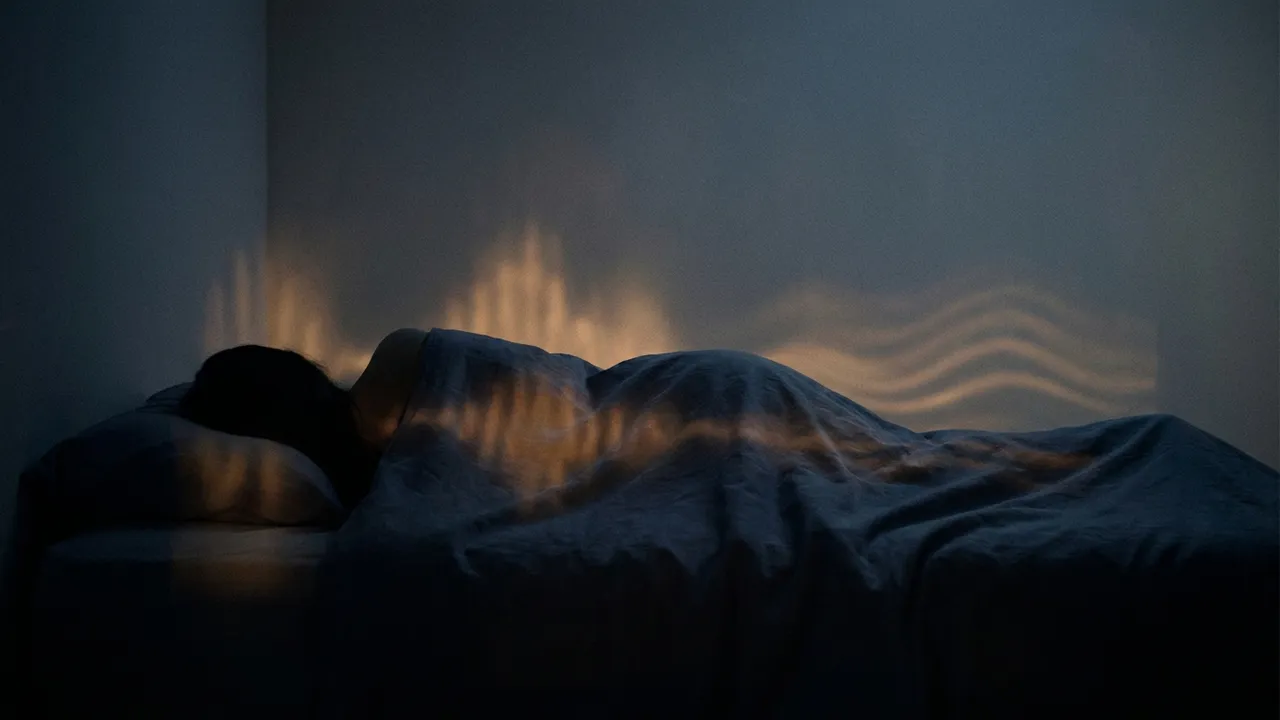
Maybe you feel heartbeat in chest when lying down, not just as a pulse but as a presence. It knocks against your sternum. It flutters in your throat. It moves the pillow under your ear. You shift from your left side to your back. You press two fingers to your wrist. You count. You lose count. You start again.
When the Fear Feeds Itself
This is where the fear often begins feeding itself. A fast heartbeat is startling. The startle sends a message through the body: pay attention. Your attention sharpens. Your breath gets higher and thinner. Your muscles brace. Your mind starts asking, why does my heart beat fast when I lay down to sleep, and underneath that question is the older, quieter one: am I safe?
Anxiety heart racing at night can become a loop. The pulse rises, so fear rises. Fear rises, so the pulse rises. The body hears your alarm and tries to help by preparing you to act, even though there is nothing to fight and nowhere to run. You are only in bed. The ceiling is only the ceiling. But your nervous system has mistaken the dark for a signal.
When to Respect a Racing Heart
Heart palpitations at night are common, and they are also worth respecting. If your racing heart comes with chest pain, fainting, severe shortness of breath, or a new irregular rhythm, you deserve medical help right away. If it keeps happening, a clinician can help rule out causes like thyroid changes, medications, sleep apnea, or rhythm issues. But for many people, especially when the pounding arrives with worry, rumination, or panic, the explanation begins in the nervous system.
Your Nervous System's Wires Are Crossed
Sleep asks the body to change states. It asks the jaw to unclench, the eyes to stop scanning, the stomach to digest what it can, the hands to warm, the breath to slow. This shift is supposed to be guided by the parasympathetic nervous system, often called "rest and digest." It is the part of you that knows how to settle.
When Fight-or-Flight Stays Switched On
But sometimes the sympathetic nervous system is still in charge. This is the "fight or flight" system. It quickens the heart, raises blood pressure, sharpens attention, and sends energy toward your limbs. It is useful when you are crossing a busy street. It is less useful at 12:47 a.m., when the only movement in the room is a curtain lifting slightly from the vent.
Cortisol Still Running High
When your heart starts to pound at bedtime, it can mean your body has not received the message that the day is over. Cortisol, one of your main alertness hormones, may still be running high from stress, late work, conflict, too much caffeine, an intense show, alcohol, or the simple accumulation of unprocessed feeling. Cortisol is not evil. It helps you wake and respond. But when it lingers at night, it can keep the body lit from the inside.
Interoception: The Body Heard Too Loudly
There is also interoception, the brain's ability to sense the inside of the body. At night, interoception can become exquisitely loud. In the day, your heartbeat competes with footsteps, screens, voices, sunlight, dishes, weather. In bed, there is very little else to notice. The default mode network, a set of brain regions involved in self-referential thought, may also grow busy when the outer world quiets. It starts sorting memories, rehearsing possible futures, returning to unfinished conversations. If you know the feeling of mental noise arriving the moment your head hits the pillow, you may recognize it from why you can't shut your brain off at night.
So the question is not only how to slow down a racing heart from anxiety. It is how to tell the body, convincingly, that the emergency has passed.
You cannot usually think your way out of a pounding heart. Thought is too high up the ladder. The body needs a message in its own language: breath, pressure, rhythm, sound, temperature. Something simple enough to reach you when you are scared.
That is where the vagus nerve enters the room.
Meet the 'Wandering Nerve' That Holds the Key
The vagus nerve is sometimes called the wandering nerve because it travels widely. It begins in the brainstem and moves through the neck, chest, and abdomen, touching the heart, lungs, and digestive organs along the way. It is one of the main pathways of the parasympathetic nervous system. A long thread of calm, running through the body.
A Long Thread of Calm
When the vagus nerve is active in the right way, it helps slow the heart. It supports digestion. It allows the breath to deepen. It tells the brain that the body is not in immediate danger. You do not have to understand all of its anatomy for it to help you. You only need to know that certain actions, especially slow exhalation, can nudge this pathway.
The Heart and Brain, Listening All Night
Think of the heart and brain as listening to each other all night. The brain sends signals downward: be alert, be ready, be still. The body sends signals upward: the chest is tight, the stomach is uneasy, the pulse is fast, the breath is shallow. When you are anxious, those upward signals can sound like proof that something is wrong. This is why sudden heart racing while sleeping or while drifting off can jolt you awake with a cold rush. Your brain receives the body's intensity and gives it a story.
The vagus nerve helps change the story by changing the signal. A longer exhale can lower arousal. A softer belly can tell the diaphragm to move. A slow hum, a gentle chant, or a guided voice can add vibration and rhythm. These are not tricks. They are body-level cues.
Why 'Just Calm Down' Is Useless
This is also why being told "just calm down" is so useless. Calm is not a command. It is a state the body enters when it has enough evidence. The evidence can be small: the warm weight of a blanket, the dimness of a room, the length of your out-breath, the steadiness of someone's voice beside you. If you live with nighttime hyper-vigilance, your system may need repeated evidence before it believes the night is safe; we write more about that in the science of nighttime hyper-vigilance.
One of the quickest ways to offer that evidence is a breathing pattern called the Physiological Sigh.
How to Slow Your Heart Rate: The Physiological Sigh
The Physiological Sigh sounds almost too small for the size of the fear. But the body often responds to small things when they are precise.
How the Physiological Sigh Works
It is a natural breathing pattern humans and animals use spontaneously, often after crying or during sleep: a double inhale followed by a long exhale. Scientists have studied it as a way to reduce stress in the moment. The basic idea is simple. The first inhale expands the lungs. The second little inhale pops open more tiny air sacs in the lungs. The long exhale helps offload carbon dioxide and shifts the body toward parasympathetic activity, partly through the vagus nerve.
The Shape of the Breath
If you are wondering how to calm heart rate for sleep while your chest is already pounding, try it without making it ceremonial. You do not need perfect posture. You do not need to sit cross-legged. You can stay exactly where you are, one hand on the sheet, one foot outside the blanket.
Here is the shape:
Take a deep inhale through your nose. Let it be full but not strained.
Before you exhale, take a second small inhale through the nose, as if you are gently topping off the breath.
Exhale slowly through your mouth, longer than you think you need to, like fogging a mirror from far away.
Then repeat.
Three rounds may soften the edge. Five rounds may help your shoulders drop. One to five minutes may give your heart enough time to receive the message. If breathing through your nose is hard, use your mouth. If a deep breath makes you feel more anxious, make the inhale smaller and the exhale longer. The point is not to perform calm. The point is to make the out-breath a little more generous than the in-breath.
Pair It With a Phrase That Doesn't Argue
You might notice the first few sighs feel awkward. That is fine. Panic makes the body suspicious of new instructions. Keep the movements gentle. Imagine you are not forcing the heart to slow down. You are opening a door and letting the parasympathetic nervous system step in.
It may help to pair the exhale with a phrase that does not argue with your fear. Not "nothing is wrong," because your body may not believe that yet. Try something truer and softer: "This is a wave." Or, "My body is trying to protect me." Or, "I can stay with this breath."
If your pulse still feels strong, place a palm on your chest or belly. Pressure gives the brain another sensation to track. The heartbeat may remain noticeable for a while, but it may stop feeling like the only thing in the room. The goal is not to erase sensation. It is to widen the room around it.
From an Exercise to a Ritual
A breathing exercise is a match struck in the dark. A ritual is the lantern you learn to keep by the bed.
Practice Before the Fear Arrives
When the heart is already racing, the Physiological Sigh can help interrupt the loop. But the deeper work is teaching your nervous system, night after night, that sleep is not a cliff you fall from. It is a shore you return to. That lesson takes repetition. Not discipline with clenched teeth. Repetition with tenderness.
If you only practice calming breath when you are panicking, your body may associate breathwork with emergency. But if you practice it before the fear arrives, while brushing your teeth, after turning down the lights, once you are under the blanket, it becomes familiar. Familiarity matters. The nervous system trusts what it recognizes.
Rhythm Remembered, and HRV
Over time, consistent slow breathing may support Heart Rate Variability, or HRV. HRV is the tiny variation in time between heartbeats. A healthy heart does not tick like a metronome; it adapts, moment by moment, to breath and movement and feeling. Higher HRV is often a sign that the body can shift more flexibly between activation and rest. You do not need to chase the number. You do not need a wearable blinking at you in bed. It is enough to know that rhythm practiced gently can become rhythm remembered.
The Body Loves Sequence
A ritual might be very plain. Lights low. Phone away from your face. A glass of water. Two minutes of the Physiological Sigh. A hand on the sternum. A voice note, a prayer, a page of something slow, the same order each night. The body loves sequence. Sequence says, we have been here before, and we survived.
This is especially important if your nights often begin with scanning. Is my heart fast? Am I tired enough? Will I sleep? What if I wake at 3? The scanning itself can keep the sympathetic nervous system awake. It is like standing guard over a garden and wondering why the birds will not land. If that hour has become charged for you, you may find comfort in why you wake up at 3 AM every night.
Ritual does not guarantee a perfect night. Nothing human does. But it gives your body a path. And when fear narrows the world to a pounding chest, a path is mercy.
A Voice to Guide You Back to Your Body
It is hard to remember instructions when your heart is loud.
The Cruel Little Truth of Anxiety
This is one of the cruel little truths of anxiety: the tools you learned in daylight can feel far away when the room is dark and the pulse is climbing. You may know exactly what to do, but knowing lives in one part of the brain, and panic has pulled the fire alarm in another. You do not want an article then. You do not want a bright screen full of options. You want someone calm to say, breathe in here, a little more, now let it go.
A guided experience can become the bridge between what you understand and what your body can do. A carefully crafted AI voice, low and unhurried, can lend you its rhythm until yours returns. The voice does not need to fix you. It only needs to keep you company long enough for the wave to pass.
Guidance as a Bridge
This matters because nighttime fear is lonely, even when someone is sleeping inches away. The person beside you may be warm and beloved, but you may still be alone with the drum in your chest. Guidance gives the mind fewer decisions to make. It takes the burden of remembering. It says, not in a grand way but in a practical one: follow this next breath.
If your heart races when you try to sleep, you are not broken. Your body is sensitive to threat, perhaps too sensitive right now, but sensitivity can be retrained. The sympathetic nervous system can learn to stand down. The parasympathetic nervous system can learn to arrive earlier. The vagus nerve can be invited, again and again, through breath and rhythm and safety repeated in the same small language.
Tonight is being built for that moment. Not as another meditation app asking you to stare at a glowing screen, but as an AI-guided evening ritual with carefully crafted voices, shaped by humans for warmth, screen-free and low-light, made for the hour when you need less information and more steadiness. If that sounds like something your nervous system has been waiting for, you can join the quiet list at Tonight.
A heart racing when trying to sleep is often a sign that your body's fight-or-flight response is still switched on, even though you are safely in bed. Stress hormones like cortisol can linger after a demanding day and keep the body alert when it would rather settle. For many people the pounding is uncomfortable rather than dangerous, but it is worth respecting if it is new or severe.
Why does my heart beat fast when I lie down to sleep?
When you lie down and the room goes quiet, there is very little else to notice, so your attention can land on your heartbeat and amplify it. This is interoception, the brain's ability to sense the inside of the body, becoming exquisitely loud at night. A fast pulse can then feed a loop where the heartbeat raises fear, and fear raises the heartbeat.
How do you calm a racing heart from anxiety at night?
A wired body tends to respond to signals rather than commands, so lengthening the exhale is one of the quickest ways to offer calm. A breathing pattern called the Physiological Sigh, a double inhale followed by a long exhale, can gently shift the body toward its rest-and-digest state. Pairing the breath with warmth, dim light, and a phrase that does not argue with your fear can help the nervous system feel safe enough to settle.
When should I see a doctor about heart palpitations at night?
Heart palpitations at night are common, but some symptoms deserve prompt attention. If your racing heart comes with chest pain, fainting, severe shortness of breath, or a new irregular rhythm, you deserve medical help right away. If it keeps happening, a clinician can help rule out causes like thyroid changes, medications, sleep apnea, or rhythm issues.
What is Tonight?
Tonight is a digital sleep ritual that helps you clear your mind and decompress. Through structured reflection and personalized, synthetic audio guidance, we provide a quiet, private space to help you find closure before you sleep. Private, ephemeral, and designed to help you rest.
The quiet list
Notes for a quieter mind.
Join the newsletter for occasional, thoughtful notes on sleep, emotional regulation, and building a calmer life. We only write when there’s something genuinely worth your while.