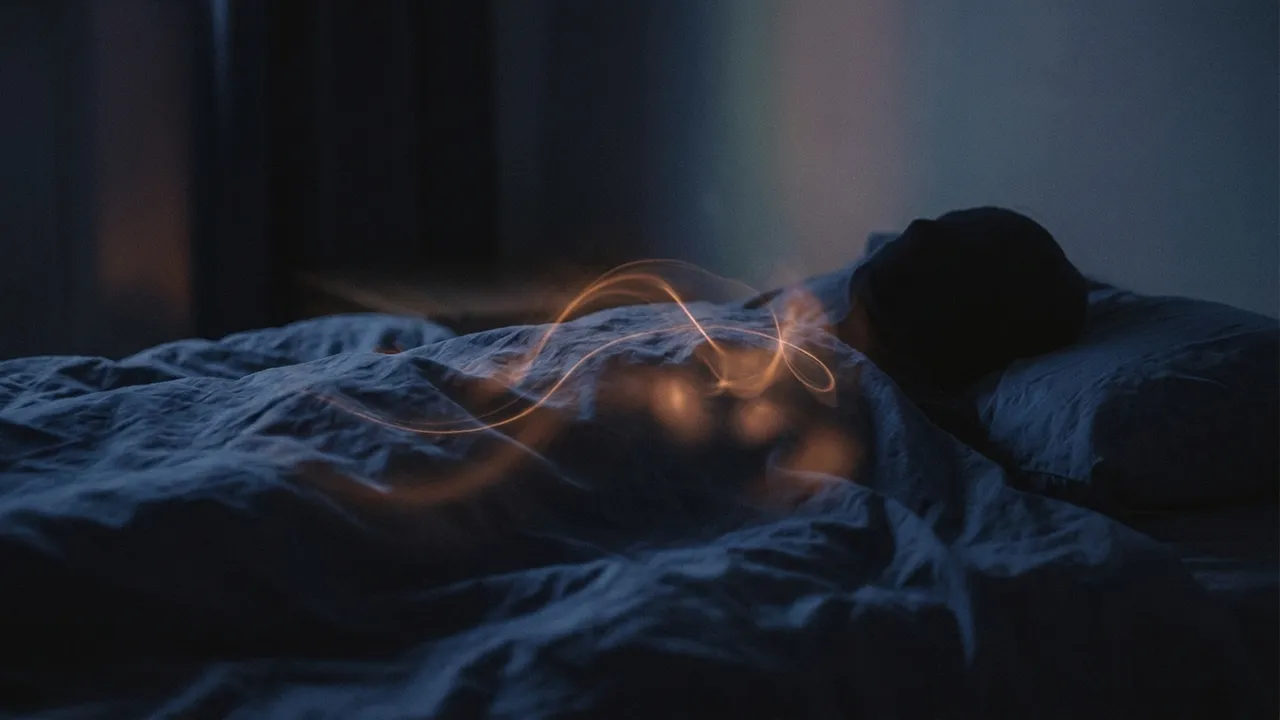
Your head is on the pillow. The room is dark. The day is technically over.
But your body has not received the message.
Your jaw is locked as if it is holding a secret. Your tongue presses against the roof of your mouth. Your shoulders have crept upward, inch by inch, until they seem to be trying to protect your ears. There is a band of tightness across your chest, or a small hard stone in your stomach. Your hands may be curled without your permission. Your calves might feel ready to run, though there is nowhere to go but deeper into the sheets.
This physical tension is a common echo of the day's stress, but there is a gentle way to guide your body toward rest.
The answer is a simple, body-based practice called Progressive Muscle Relaxation (PMR), where you intentionally tense and then release your muscles. This process communicates safety directly to your nervous system, inviting it to let go.
You are not failing at sleep. Your body is bracing. And bracing is something the body learned to do in order to protect you.
Lying in Bed, Feeling Like a Tightly Coiled Spring?
Your head is on the pillow, but your body is still braced for impact.
This is the peculiar cruelty of sleep tension and anxiety: you can be exhausted and still unable to soften. Your mind may want oblivion. Your muscles may vote otherwise.
What You Need Tonight, in the Dark
If you are searching for how to relax your body when tense for sleep, you are probably not looking for a speech about healthy habits. You are in bed now. You do not need a lecture about caffeine at 3 p.m. or a perfect morning routine. You need something you can do in the dark, under a blanket, with the body you have tonight.
The feeling can be frightening because it seems so physical. You may think, I can't relax muscles to sleep. Something must be wrong. But physical anxiety symptoms at night often arrive exactly this way: a clenched belly, a buzzing chest, a pulse you can hear, a throat that will not unclench. The body speaks in pressure and heat, in tightening and release.
Why Trying Hard to Relax Backfires
There is a paradox here. Trying hard to relax usually makes the body grip harder — a phenomenon clinicians call relaxation-induced anxiety, first documented in the Journal of Anxiety Disorders (Heide & Borkovec, 1984). The command "calm down" can land like another demand. So the way in is gentler. Not force. Not performance. A conversation.
Tonight, that conversation can begin with noticing what is already true. The sheet against your ankle. The weight of your ribs. The place where your teeth meet.
Why Your Body Carries the Day's Stress to Bed
Your body does not separate the day into neat chapters. It carries unfinished signals.

A tense meeting. A difficult text. A child's fever. A bill. A hallway conversation that left a splinter in your chest. Even hours later, your nervous system may still be responding as if there is something to solve, guard against, or outrun.
The Fight-or-Flight Response, Long After the Threat
This is the fight-or-flight response. It is not a character flaw. It is an old biological pattern. When your brain senses threat, the sympathetic branch of the Autonomic Nervous System helps prepare you to act. Cortisol and adrenaline rise. Breath gets shallower. Heart rate shifts. Blood moves toward large muscles. Shoulders tighten. Jaw sets. Hips and legs prepare for movement.
A tired person can read it this way: your body tightens because it thinks tightening will help you survive.
When Stress Has No Clean Ending
The trouble is that modern stress often has no clean ending. The email is answered, but the tone still echoes. The door is locked, but the body still listens. The child is asleep, but your chest remembers the fear. Without an unmistakable all-clear, the muscles can keep holding the shape of alarm long after the stressor is gone.
This is why your body can feel too tense to sleep even when nothing is actively happening. Bedtime removes distraction. The room gets quiet, and the sensations step forward. The default mode network, a set of brain regions active when the mind wanders inward, may begin sorting through memories and unfinished concerns. If your mind is also racing, you may recognize the same loop described in Why You Can't Shut Your Brain Off at Night. Thought and muscle can feed each other. Worry tightens the body. Tightness convinces the mind there must be danger.
Why the Body Won't Believe Your Words
The Vagus Nerve is part of the body's calming pathway, helping regulate breath, heart rhythm, digestion, and the felt sense of settling. But it does not always respond to words alone. You can tell yourself, I am safe, and still feel your abdomen clench.
That does not mean safety is unreachable. It means the message may need to be delivered in the body's own language.
The Language of the Body: How to Say 'It's Safe to Let Go'
The body understands sensation before it understands explanation.
That is why a warm cup can soothe before you know what you feel. Why a hand on the chest can matter. Why the smell of rain through a cracked window can loosen something behind the ribs. The body is not a machine waiting for instructions. It is an animal listening for cues.
Meet Progressive Muscle Relaxation (PMR)
Progressive Muscle Relaxation, or PMR, is one of the simplest ways to give those cues. Developed in the early twentieth century and still used in sleep and anxiety care, progressive muscle relaxation for sleep works by intentionally tensing a muscle group, then releasing it. You do not tense to punish the body. You tense gently so the body can feel the contrast. Holding. Letting go. Effort. Ease.
Fluent in Tension, Illiterate in Release
This contrast matters because many of us have become fluent in tension and nearly illiterate in release. You may not notice your shoulders are lifted until they drop. You may not know your brow has been working all day until it finally softens. PMR teaches the nervous system the pathway from bracing to rest, one small region at a time.
Interoception and Proprioception: Learning to Feel
It also strengthens interoception: your awareness of inner body states, a capacity that Biological Psychiatry has linked to emotional regulation and mental health. Interoception is how you know your stomach is tight, your breath is shallow, your hands are warm, your chest is loosening. Interoception exercises for sleep do not ask you to analyze yourself. They ask you to feel, simply and specifically. This is pressure. This is warmth. This is pulsing. This is softer than before.
PMR also uses proprioception, your sense of where your body is in space and how your muscles are working. When you press your heels down or make a gentle fist, you give the brain clear information: here are the edges of me; here is effort; here is release. That clarity can be deeply settling.
Somatic Experiencing, another body-based approach, often works with small, tolerable sensations rather than forcing a dramatic emotional breakthrough. PMR shares that kindness. You do not need to excavate the whole day. You can begin with your feet.
If nighttime leaves you scanning for danger in the dark, you may also find comfort in The Science of Nighttime Hyper-Vigilance. For now, let this be enough: your body can learn a new ending to the day.
A Guided Practice for Releasing Physical Tension
You can do this practice lying down. No screen is needed once you know the path. Let the room be as it is. Let the blanket have weight. If any movement causes pain, skip it. Tense only to about half your strength. This is not exercise. It is a signal.
The Rhythm: Tense, Release, Notice
The rhythm is simple: tense for five seconds, release for ten to fifteen seconds, then notice the difference. Move slowly. Let each release be longer than each effort.
Begin with Your Feet, Then Climb the Body
Begin with your feet. Curl your toes gently, or press your heels into the mattress. Hold for five seconds: one, two, three, four, five. Then let go. Let the toes uncurl. Let the soles spread. Notice any warmth, tingling, heaviness, or quiet.
Move to your calves. Point your toes slightly away from you, enough to feel the lower legs engage. Hold. Then release. Imagine the muscles pouring downward into the bed, like warm water finding the lowest place.
Now your thighs. Press the backs of your knees down, or gently tighten the tops of your legs. Hold without strain. Release. Let the thighs widen. Let the hips be carried.