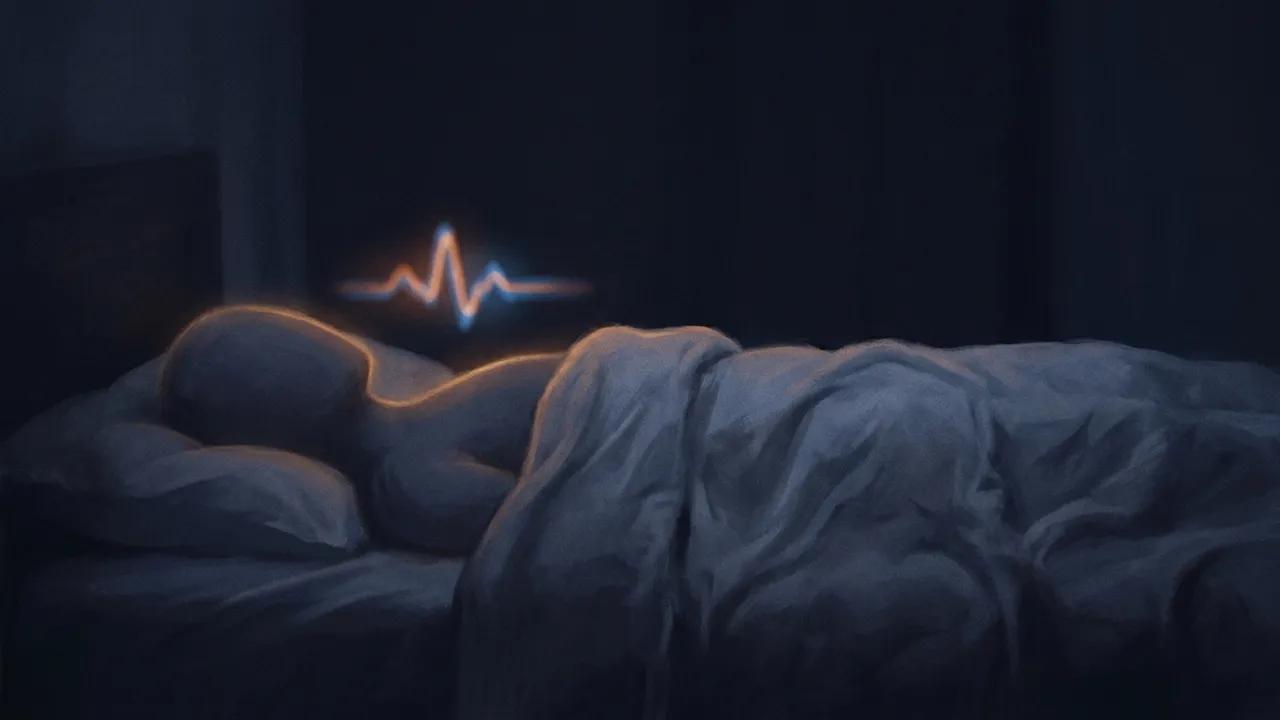
There is a particular kind of night that feels almost insulting.
Your body is done. Not gently tired. Not pleasantly drowsy. Done. Your calves feel hollow. Your shoulders have sunk toward the mattress like wet wool. Your eyes burn with that dry, papery ache that comes after too much day. You have wanted this bed for hours.
And then, the moment the room goes quiet, your brain sits up.
It starts sorting through the inbox of your life. The sentence you should not have said. The bill. The appointment. The strange look someone gave you in the kitchen at work. A memory from twelve years ago arrives with its shoes on. Then another. You turn your pillow over. You check the time. You do the math that never helps: if I fall asleep now, I can still get six hours. Five and a half. Five.
This is the tired but wired feeling at night.
If you have ever thought, why am I so tired but can't fall asleep, you are not being dramatic. Something real is happening. Not a failure of will. Not a lack of discipline. Not proof that you are broken at some hidden seam.
The Cruel Joke of Being Exhausted But Awake
It can feel like a betrayal. Your body is asking for mercy while your mind is running bright laps in the dark. The body tired mind awake split is so vivid that it seems as if two different creatures are sharing one bed, each with its own agenda.

You are exhausted, but your system has not received the message that it is safe to let go.
When Your Body Is Done But Your Brain Sits Up
Sleep asks for surrender. A wired brain does not surrender easily. It scans. It rehearses. It tries to prevent tomorrow by solving it tonight. Sometimes, the harder you try to sleep, the more awake you become, because effort itself has a temperature. It warms the room. It calls the mind back to work.
The State With a Name: Hyperarousal
There is a name for this state. Hyperarousal. It sounds clinical, but the experience is intimate: the heart a little too present, the breath a little too high in the chest, the thoughts too quick for the hour. If your brain won't stop, you may find comfort in knowing the pattern is shared by many sleepless people, and it has a body behind it. We wrote more about that restless mental brightness in why you can't shut your brain off at night, but here we'll stay close to the central paradox: too tired to sleep but brain won't stop.
The good news is quiet and practical. If the problem is not simply your thoughts, but your nervous system, then the path back is not arguing with your thoughts. It is speaking to the body in a language the body understands.
Why This Happens: A Mismatch in Your Nervous System
Your Alarm System Stays On
Hyperarousal is your body's alarm system staying on after the danger has passed, or turning on when there is no danger at all. At night, it can feel absurd. You are in bed. The door is locked. The room is familiar. Maybe there is a glass of water on the nightstand, a book face down, the small blue shadow of a chair in the corner. Nothing is chasing you.
But the nervous system is older than language. It does not only respond to facts. It responds to patterns.
When you have been under strain for days, weeks, or months, your body learns the shape of vigilance. It learns deadlines, conflict, caregiving, financial worry, grief, too much screen light, too little daylight, too many coffees, too many hours spent pretending you are fine. Even one acutely overtired day can press the system past its natural edges. You push through the afternoon. You miss the first soft window of sleepiness. You answer one more message. You keep going.
Then your body makes a survival decision.
Cortisol, the HPA Axis, and the Wrong Hour
The HPA Axis—the Hypothalamic-Pituitary-Adrenal Axis—is one of the body's main stress-response pathways. In plain words: the brain senses stress, signals the hormone system, and the adrenal glands release cortisol. Cortisol is useful in the morning. It helps you wake, focus, move. It is not evil. It is a dawn hormone, a get-up-and-handle-this hormone.
But when cortisol is keeping me awake becomes the nightly feeling, the rhythm has slipped. Stress or sleep deprivation can nudge cortisol into the wrong part of the night. The body says, we have gone too far; stay alert. It is trying to protect you with the tools it has.
This is where the phrase adrenal fatigue can't sleep often appears online. Many people use it to describe a real misery: exhaustion paired with agitation, burnout paired with insomnia. The formal science around "adrenal fatigue" as a diagnosis is contested, but the lived sensation is not. Chronic stress can absolutely disturb the HPA Axis. Cortisol can rise at unhelpful hours. Your body can feel both depleted and activated.
Safe, But Signaled Otherwise
The animal body knows this old equation: when you are past your limits, do not collapse until you are safe.
That equation once helped us survive. It kept watch on cold ground, in dark woods, among real threats. But the modern bedroom can confuse it. A glowing phone, an unfinished argument, a tomorrow morning presentation, a child coughing down the hall—your system may read them all as reasons to remain on guard.
So there you are. Safe, but signaled otherwise. Tired, but mobilized. The alarm has mistaken your pillow for a lookout post.
Sleepiness vs. the Ability to Sleep
The Two Tides of Sleep
Sleep is not one switch. It is more like two tides meeting, what sleep researchers call the two-process model, first proposed by Alexander Borbély and reappraised in the Journal of Sleep Research.
The first tide is sleep pressure. Sleep pressure builds the longer you are awake. It is the heavy sandbag feeling behind your eyes, the slow blink, the desperate wish to lie down on any available surface. Chemically, it is related in part to adenosine, a substance that accumulates during wakefulness. The longer you go without sleep, the more pressure gathers.
The second tide is your circadian rhythm, the inner clock that helps your body know when to be awake and when to release into night. Light, timing, meals, movement, and habit all whisper to this clock. In a kinder evening, sleep pressure is high and the circadian signal is saying yes, now. The body dims. The mind loosens. You drift.
When Hyperarousal Overrides Both Tides
But when you are too tired to sleep but brain won't stop, another force has entered the room.
Hyperarousal can override both tides.
You may have enormous sleep pressure. You may be so tired your bones seem to hum. But if your nervous system is flooded with alertness, your ability to sleep is blocked. The battery is empty, but the "on" switch is stuck. This is why sleep deprivation can sometimes make sleep harder, not easier. Overtiredness is not always a straight road to rest. Sometimes it is a cliff edge where the body, sensing depletion, releases more stress chemistry to keep you functioning.
This helps explain the maddening feeling of being exhausted but my mind is racing. You are not lacking sleepiness. You are lacking access.
The door is there. You can see the door. You are leaning your whole tired self against it. But your body has thrown the bolt from the inside.
Why You Can't Think Your Way Through
Trying to think your way through this can make the bolt tighter. The default mode network, a brain system involved in self-reflection and mental time travel, can become very active when the world goes quiet. At midnight, it may start stitching together old scenes and future worries. This is why bed can become a small theater for everything unfinished.
You do not need to win a debate with that theater. You do not need to solve your life before you are allowed to sleep.
You need a downshift.
A downshift is different from a command. "Go to sleep" is a command, and the nervous system often resists commands. A downshift is a bodily cue: slower breath, unclenched jaw, longer exhale, warmth, darkness, a trusted voice. It tells the animal inside you that the watch can end.
For some people, nighttime alertness has the sharpness of hyper-vigilance, especially after stress or unsafe seasons of life. If that feels familiar, the science of nighttime hyper-vigilance may help you understand why rest can feel complicated even when you want it badly. But tonight, you can begin with one small lever that is always with you: breath.
A Quick Reset for Your Nervous System: The Physiological Sigh
A Breathing Pattern Your Body Already Knows
The physiological sigh is not a mood. It is not an affirmation. It is a breathing pattern your body already knows.

You may have seen it in a child after crying: a shaky inhale, another little sip of air, then a long release. You may have done it without thinking after a scare, or in the middle of a hard conversation, or while sitting alone in a parked car before going inside. The body sighs when it is trying to rebalance.
How the Double Inhale and Long Exhale Work
Neuroscientists, including Andrew Huberman and colleagues, have studied this pattern as a fast way to reduce physiological arousal, finding in a 2023 Cell Reports Medicine trial that cyclic sighing outperformed mindfulness meditation for improving mood and lowering respiratory rate. The idea is simple enough for a tired person at midnight: take a deep inhale, add a second small inhale on top, then let out a long slow exhale.
That double inhale helps reopen tiny air sacs in the lungs called alveoli and improves the exchange of oxygen and carbon dioxide. The long exhale helps offload carbon dioxide. Too much carbon dioxide can add to the feeling of air hunger or bodily tension. When you exhale slowly and fully, the body receives a message that it is no longer in emergency mode.